The Perks of Being a Wallflower, based on the bestselling novel by Stephen Chbosky, follows high school freshman "Charlie," the name being an alias to protect his identity. Charlie narrates the film, much like he did in the novel, as though he were writing to an anonymous "friend." Without having read the book, I can see that parts of the film would be difficult to decipher, since a lot of the messages and themes portrayed in the book are through subtext. In this way, if you watch the film once, then watch it again later, you start to pick up on elements you may be kicking yourself for not getting the first time.
The film is about a boy, Charlie, who is a wallflower (see: loner). Before the events of the film, he witnessed his best friend commit suicide. In addition to that scarring incident, there are elements of his past that are unexplained to the viewer that shape his personality. Before long, he meets Sam, Emma Watson's character. She is a classic example of the Manic Pixie Dream Girl motif. Essentially, she is a character that exists only to break the main character (generally a male) out of their shell by getting them to do things that are out of their comfort zone. It is an overused but nevertheless popular characterization that wasn't as common when the novel was written in 1999, but is all too common today. Regardless, Emma Watson played her part beautifully and the chemistry with Charlie (Logan Lerman) was palpable.
Besides facets of the story being fairly generic, there are parts that are underrepresented in mainstream film. Topics like homosexuality and abuse are explored in ways uncommon to films for the target age group. I recommend this film to teens and twenty-somethings struggling with their identity and place in the world (so pretty much anyone age 13-29).
Bookophile Rating: Excellent (For pushing the boundaries and dealing with tough issues in a well-acted, well-directed film)
Thursday, April 4, 2013
Wednesday, April 3, 2013
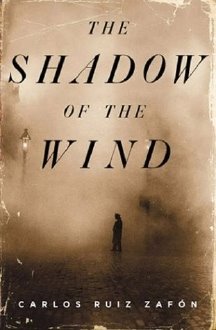
Book Review: The Shadow of the Wind
The story begins with young Daniel Sempere being led to the Cemetery
of Forgotten Books by his father. There,
he picks out a book written by Julián Carax.
Soon, he discovers that someone is tracking down all of Carax’s books
and destroying them. Daniel becomes
obsessed with the elusive author of the novel he cherished, soon becoming
entwined in events he never imagined possible.
The Shadow of the Wind
is a story about love, finding oneself, and any number of cliché reasons to
write a book. However, I have never read
a book that described so vividly the feelings boiling over in the hearts of the
characters. Daniel became real to me
within the first quarter of the novel, so that what he experienced, I felt I
too experienced. While the themes in the
novel are nothing groundbreaking, the execution and story surrounding those
themes is so well done, I found myself caring more about the message than I
would have if I simply read a synopsis and analysis of the book. It’s a book you have to experience for
yourself to understand what I mean.
Bookophile Rating: Ludicrous! (For some of the best characters and certainly one of the best books I’ve
ever read).
Tuesday, April 2, 2013
Book Review: City of Bones
The story revolves around a teenage girl, Clary, who witnesses a supernatural murder. After a series of events, she finds herself thrust into a world of angels and demons in which her role is far more important than everyone (except the reader) foresees. Clary discovers she is a Shadowhunter, or, a half-human, half-angel demon-killing machine. Being the first book in a trilogy, City of Bones sets itself up for its sequels nicely, but ends in an anticlimactic and abrupt fashion.
The first couple chapters sparked my interest, but it was mostly downhill from there. The sentence structure was juvenile, which makes sense based on the target audience (teen girls who are normally not voracious readers). The characters were thinly portrayed and leave a lot open to reader interpretation. This quality might actually help the film version, as the director and actors can use creative license to really mold their own characters to whatever they wish. About the only thing Cassandra Clare does well is end each chapter with a cliffhanger, enticing the reader to continue on their path to mindless entertainment.
Bookophile Rating: Poor (For a predictable story that is poorly executed, yet somehow addicting).
Labels:
Book Review,
Bookophile,
Cassandra Clare,
City of Bones,
City of Bones Review,
The Mortal Instruments
Tuesday, November 13, 2012
Replica: A Short Story
Please check out my newest short story, entitled Replica.In the year 2054, Army Sergeant Logan Martel hunts for an insurgent plotting a horrific attack on the west. It is in this world of high-tech equipment and prolific robotics that Logan finds himself set adrift, searching for what's left of his own humanity. Will he find what he's looking for? Or will he become merely a replica of his former self?
This 4,464 word Short Story will make you question the future of robotics and humanity. Available on Amazon for .99 cents. Nook version coming soon.
Labels:
action,
adventure,
Bioethics,
Biotechnology,
Cybernetics,
Futurist,
robotics,
Robotics Story,
Science,
Science Fiction,
war
Sunday, November 11, 2012
Book Review: The Natanz Directive
The writing style was really the only downside of this novel. The main character was likeable enough, but the sentences were written awkwardly and there were many out-of-place references to songs that disrupted the flow of the story. Ultimately I was glad I slogged through the first two thirds of the novel so I could reach the climax, which was exciting, though I feel it wrapped things up too quickly and too nicely. This was perhaps the only deviation from the realm of possibility in the novel. Real covert missions seldom wrap up that nicely with a little bow on top. I would expect there to be political consequences, inquiries, a change in international ties, or something as a result of this mission. None of those consequences were mentioned and it felt as though the author said, "And they lived happily ever after. The end." Give me a break.
Bookophile Rating: Average (For a decent story that failed mostly in the subtle underpinnings and performed about average in everything else).
Labels:
Espionage,
International Espionage Thriller,
Iranian Nukes,
Jake Conlan,
The Natanz Directive,
Thriller,
Wayne Simmons
Saturday, November 10, 2012
Book Review: The Hunters
The Hunters, written by James Salter, is a gritty tale of Korean War pilots attempting to become "aces" by felling five enemy MiGs. The story is centered around Captain Cleve Connell and his fighter wing. Within the ranks there are bitter rivalries and the best of friends, but one prevailing theme is wingmanship.
The writing itself was juvenile at times and powerful yet simple in others. Every once in a while, Salter came through with a real gem of a thought, though the rest of the novel seemed to drag its feet from plot point to plot point. Thinking of the novel in retrospect, however, those key moments that were done well are the ones best remembered. Luckily, the novel is short enough that it didn't feel as though I was wasting my time because the overarching plot was actually interesting.
The book is very loosely based on Salter's time in the Korean War which shows through with his thorough insight into what it was like to be a fighter pilot in the fifties. Despite parts that dragged and sporadic infantile sentence structure, I would recommend this book to those that are interested in Air Force history or aviation. I would not recommend this book to those who cherish good storytelling in addition to a good story. Sometimes, it's all in how it's said.
Bookophile Rating: Average (For poor sentence structure and story flow, but redeeming qualities in overall plot and quaint fifties nuances).
The writing itself was juvenile at times and powerful yet simple in others. Every once in a while, Salter came through with a real gem of a thought, though the rest of the novel seemed to drag its feet from plot point to plot point. Thinking of the novel in retrospect, however, those key moments that were done well are the ones best remembered. Luckily, the novel is short enough that it didn't feel as though I was wasting my time because the overarching plot was actually interesting.
The book is very loosely based on Salter's time in the Korean War which shows through with his thorough insight into what it was like to be a fighter pilot in the fifties. Despite parts that dragged and sporadic infantile sentence structure, I would recommend this book to those that are interested in Air Force history or aviation. I would not recommend this book to those who cherish good storytelling in addition to a good story. Sometimes, it's all in how it's said.
Bookophile Rating: Average (For poor sentence structure and story flow, but redeeming qualities in overall plot and quaint fifties nuances).
Labels:
Air Force,
Captain Cleve Connell,
James Salter,
Korean War,
Korean War Novel,
Novel,
The Hunters,
Wingmanship
Friday, November 9, 2012
Book Review: Physics of the Future
For several years I've turned on the TV and watched the silver-haired physicist Michio Kaku equate complex theoretical physics to something the lay-person can relate to. This book is no different. Physics of the Future takes the form several futurists have used in the past, but one that is relevant today. Like Jules Verne, Kaku makes bold predictions of how the next century will pan out. In retrospect, Verne's predictions were mostly conservative, regardless of how outlandish they must have seemed at the time. However, Kaku consulted with over 300 scientists at the top of their respective fields to weave a tapestry of what future advancements could look like. It was with that mindset that I began reading Physics of the Future.Michio Kaku splits up his volume into several chapters, each dealing with a different type of technological advancement. I found the chapters on Biotechnology and Medicine the most interesting, though they dealt little with physics. It seems only a matter of time, by Kaku's calculations, that humans will be able to live forever, or near enough to make no matter. Growing new organs, robotic limbs, soon the stuff of science fiction will not only be possible, it will be commonplace. Kaku's vision of the future is more optimistic than others I've read in the past. It seems his work is focused on what can be accomplished without any setbacks or global catastrophes. I, for one, believe the next hundred years could look a lot different if things keep going the way they are. However, people in the late 19th and early 20th century probably thought the same in their time, only to be proven wrong in the end. Most of Kaku's predictions are probable, which makes you think about how little our world has advanced in previous centuries as compared with the previous hundred years and certainly the coming hundred years.
Bookophile Rating: Good (For optimism and insight into the possibilities that only a few years ago would have been laughed at as impossible)
Labels:
Futurist,
Michio Kaku,
Physics of the Future,
Science,
Science Fiction
Subscribe to:
Posts (Atom)